FILM STUDIO SCI-FI TUTORIAL
Sci-fi works best when the futuristic world supports an emotional mystery. Define the technology, the central question, and what the discovery means to your lead character.
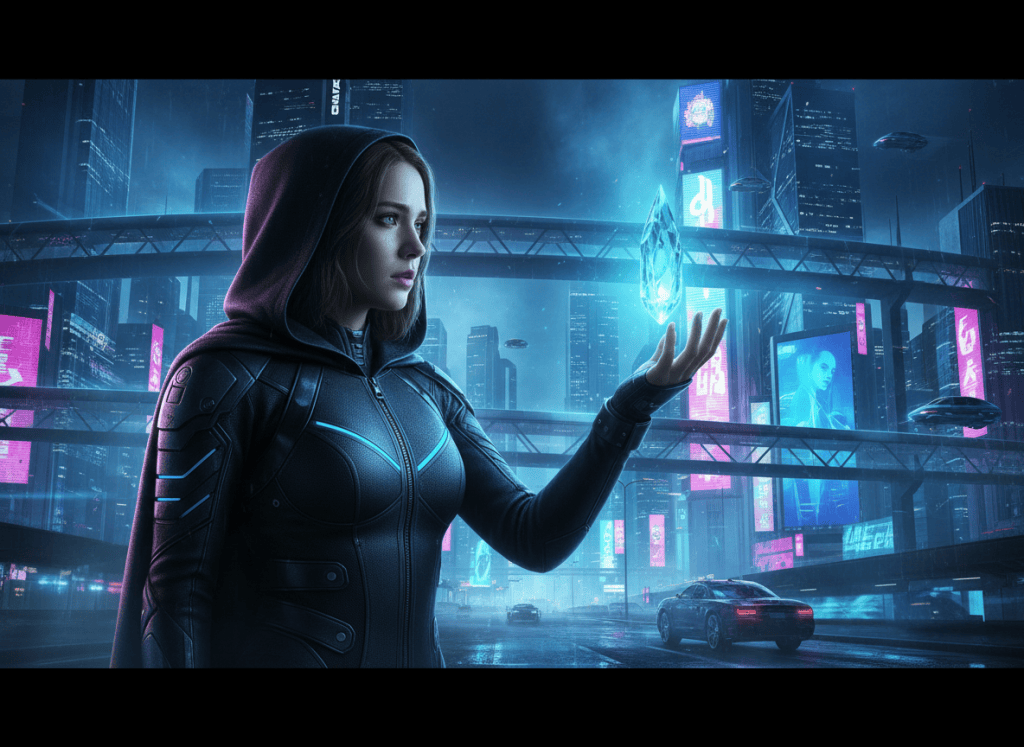
Story Concept
Nova finds a glowing memory shard in a neon city. Someone powerful tried to erase what it contains, and the deeper she looks, the more she realizes the stolen memory may be connected to her own identity.
Build Your Characters
- Nova — resourceful, guarded, observant.
- A corporate enforcer or surveillance system — controlled, relentless pressure.
- A memory-echo or hologram — the voice that reveals what was erased.
Scene Plan
- Nova discovers the shard.
- It activates and reveals a hidden memory fragment.
- Surveillance closes in.
- Nova learns the memory is tied to her own past.
- She chooses whether to expose the truth or disappear.
Visual & Camera Direction
- Use wide neon city shots to establish scale.
- Return repeatedly to close-ups of the memory shard.
- Keep Nova’s face, clothing and hairstyle consistent.
- Let the final revelation land through reaction before spectacle.
Build the Sci-Fi Story from One Rule at a Time
Science fiction becomes confusing when every scene introduces a new technology, location and threat. Anchor the film around one understandable rule: the memory shard stores something deliberately erased. Every scene should deepen what Nova knows about that same object and what it costs her to keep following it.
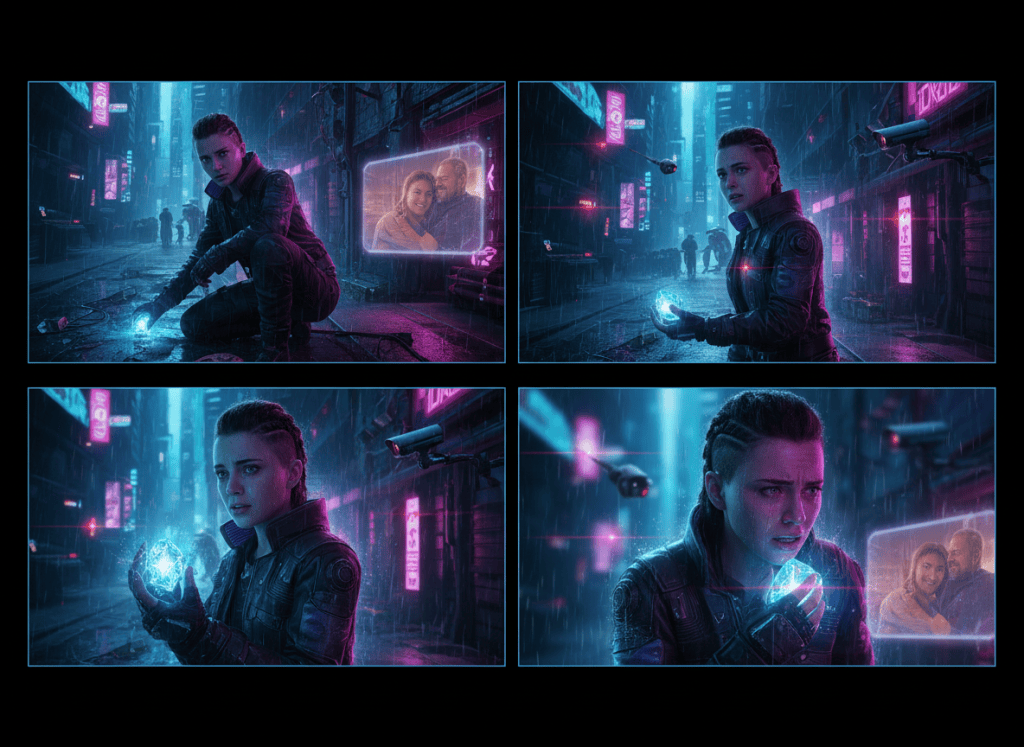
Let Each Scene Change What the Shard Means
| Scene | Carry Forward | New Information | Exit Beat |
|---|---|---|---|
| 1 · Discovery | Nova, city, shard | The object responds to her | It reveals a memory fragment |
| 2 · Decode | Same shard and visual language | The memory suggests deliberate erasure | Surveillance activates |
| 3 · Pursuit | Knowledge from the memory | Nova learns who wants it hidden | A personal detail appears |
| 4 · Revelation | All previous clues | The erased past belongs to Nova | She must choose what to do with it |
| 5 · Decision | Shard, threat and personal truth | Expose, preserve or destroy the memory | Resolve the choice, not every mystery |
Lock the Technology the Same Way You Lock a Character
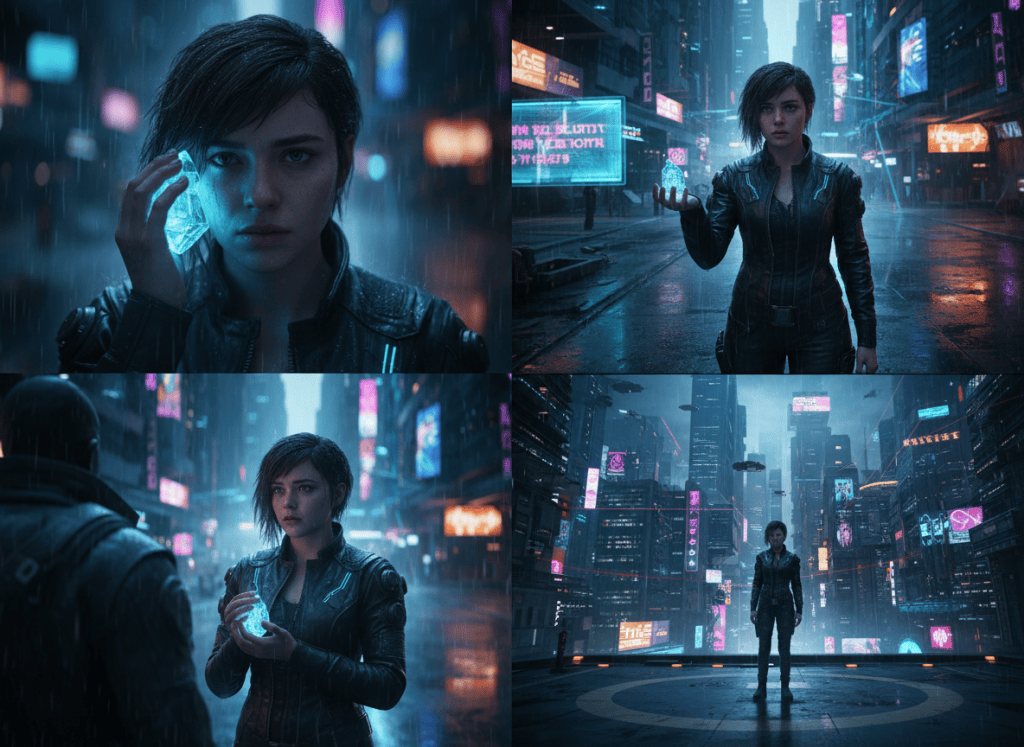
- Shard lock: repeat its shape, material, glow color, size and behavior in every prompt.
- Technology rule: decide whether it projects memories, plays them internally, or interfaces with another device. Do not change the rule halfway through.
- City lock: keep the same era, architecture, signage style, weather and neon palette unless the story deliberately moves locations.
- Nova lock: preserve face, clothing, hair and any wear or damage accumulated during the story.
- Knowledge lock: once Nova learns something, later scenes should build on it rather than repeat the same discovery.
Prompt-Stack the Worldbuilding
- Scene 1 defines only the technology the audience needs now.
- Scene 2 inherits every established rule and adds one capability or clue.
- Scene 3 introduces the system watching Nova, but keeps its visual design consistent thereafter.
- Scene 4 connects the external sci-fi mystery to Nova’s internal emotional story.
- Scene 5 uses the established technology to force a decision, rather than introducing a new gadget to solve the plot.
Use Visual Motifs to Help the Audience Follow Complex Ideas
- Repeat the shard’s glow color whenever memory information is active.
- Use a contrasting surveillance color or interface language for the corporation.
- Return to the same close-up angle on the shard when new memory layers unlock.
- Let Nova’s reactions become more personal as the information shifts from abstract conspiracy to her own past.
Common Sci-Fi Prompt Mistakes
- Adding a different futuristic device in every scene.
- Changing what the shard can do simply because the plot needs a shortcut.
- Overloading the prompt with world history the audience never sees.
- Making the city visually inconsistent between connected scenes.
- Forgetting the emotional question underneath the technology.
Expand The Memory Thief into a Longer Story
Expand by dividing the mystery into layers of access: first memory fragment → person in the memory → location in the memory → reason it was erased → Nova’s connection → consequence of revealing it. Each layer can support several scenes without changing the core technology or central question.
FILM STUDIO STRATEGY
Give the Technology a Story Purpose
The strongest sci-fi prompt explains what the futuristic object does and why it matters emotionally. That gives Film Studio a story to follow rather than only a visual style.
Copy This Film Studio Prompt
Create a cinematic sci-fi short film in ShiMuv Film Studio called “The Memory Thief.” Main character: Nova, a resourceful young woman in dark futuristic clothing. Setting: a neon-lit future city with holograms, flying vehicles, reflective streets and blue-magenta atmospheric light. Central object: a glowing memory shard containing information someone powerful tried to erase. Create 5 connected scenes: Nova discovers the shard; it activates and shows a fragment of a hidden memory; surveillance or corporate forces begin hunting her; she learns the memory is connected to her own erased past; she chooses whether to expose the truth or disappear. Include cinematic city establishing shots, close-ups of the shard, emotional reactions, consistent character appearance and wardrobe, natural dialogue, clear scene transitions, and subtitle-ready dialogue. Make it feel like a complete premium short film, not a trailer.TRY THIS IN SHIMUV