FILM STUDIO THRILLER TUTORIAL
A one-location thriller is ideal for teaching Film Studio how to build tension deliberately. Limit the environment, define the clue, and make every scene increase uncertainty.
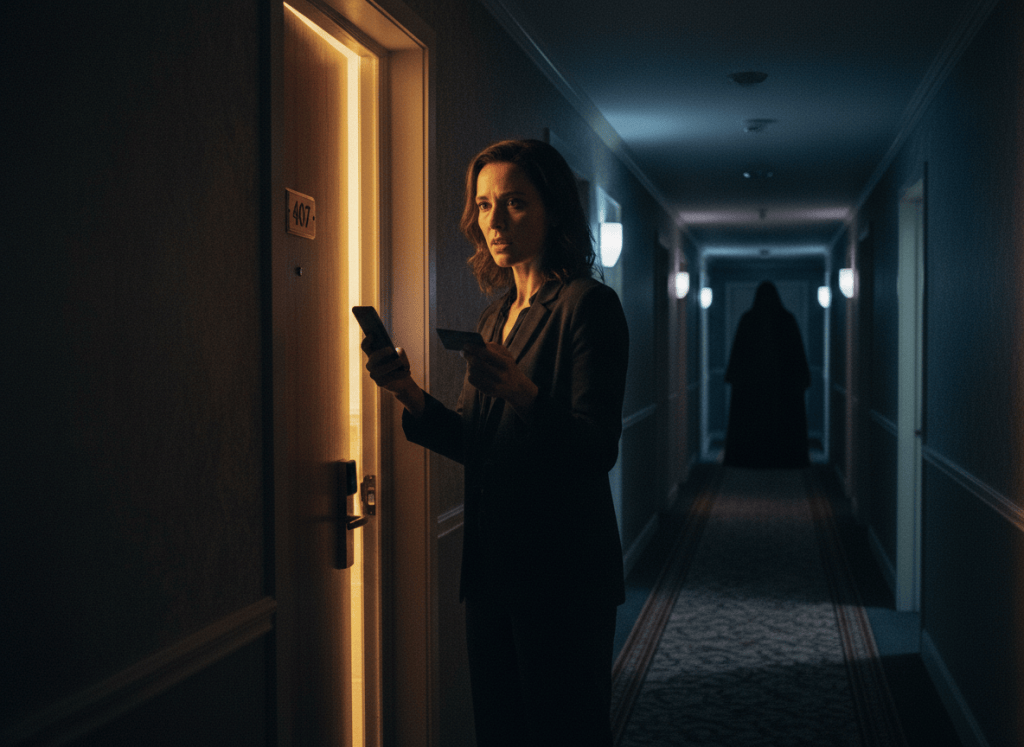
Story Concept
Claire receives a message telling her to come to Room 407 alone. When she reaches the dim hotel corridor, the door is already open, the room appears recently occupied, and she begins to suspect the invitation is connected to a secret from her past.
Build Your Characters
- Claire — anxious but determined.
- The unseen sender — present through messages, sound or implication.
- An optional watcher — a distant figure used sparingly.
Scene Plan
- The message arrives.
- Claire walks the corridor and senses she is watched.
- She reaches the already-open door.
- She finds evidence someone was there.
- End on a non-graphic reveal or reaction.
Visual & Sound Direction
- Use hallway depth to make empty space feel threatening.
- Hold on Claire’s reaction before showing what she sees.
- Repeat close-ups of the phone, keycard and door number.
- Use footsteps, room tone and distant sounds instead of constant music.
Build Suspense by Controlling Information
In a thriller, the next scene should not simply become “scarier.” It should change what Claire knows, what she suspects, or how safe she believes she is. Keep the geography and props stable while revealing information in carefully measured steps.
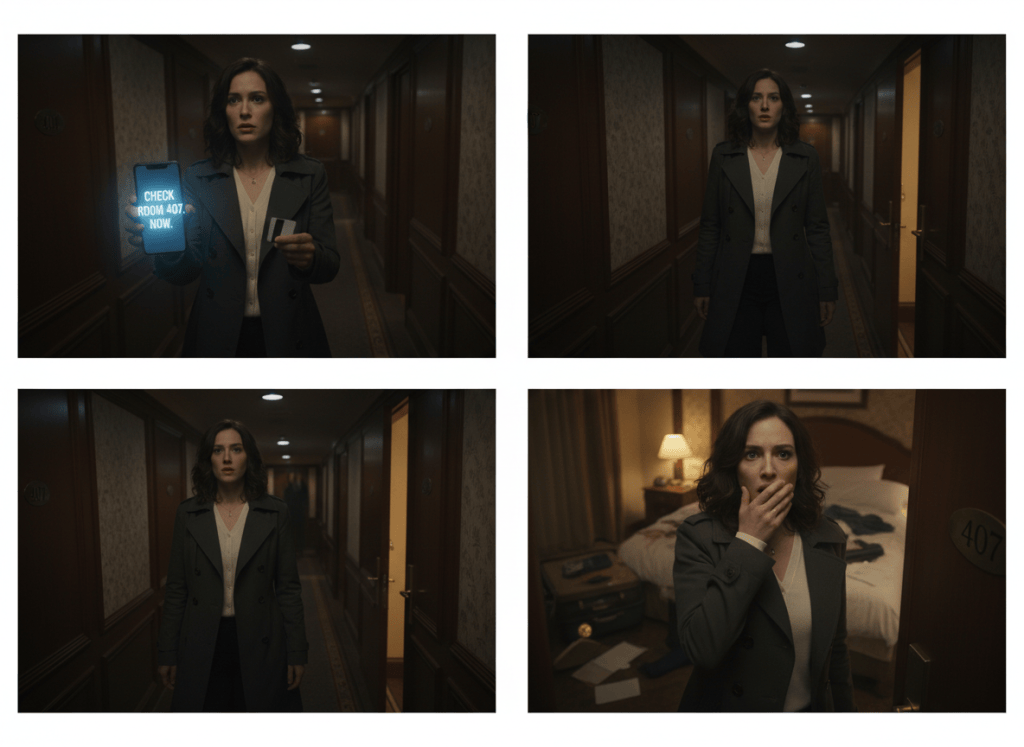
Reveal One Piece of Information Per Scene
| Scene | Known Already | Reveal Now | Question Created |
|---|---|---|---|
| 1 · Message | Claire is at the hotel | Someone wants her in Room 407 | Who sent it? |
| 2 · Corridor | Message and room number | She may be watched | Is the watcher connected? |
| 3 · Door | Watcher possibility | The door is already open | Was someone expecting her? |
| 4 · Evidence | Room was intentionally accessible | A personal clue links to her past | Why was Claire chosen? |
| 5 · Reveal | All prior clues | One answer changes her understanding | Leave one larger question unresolved |
Lock the Hallway Geography
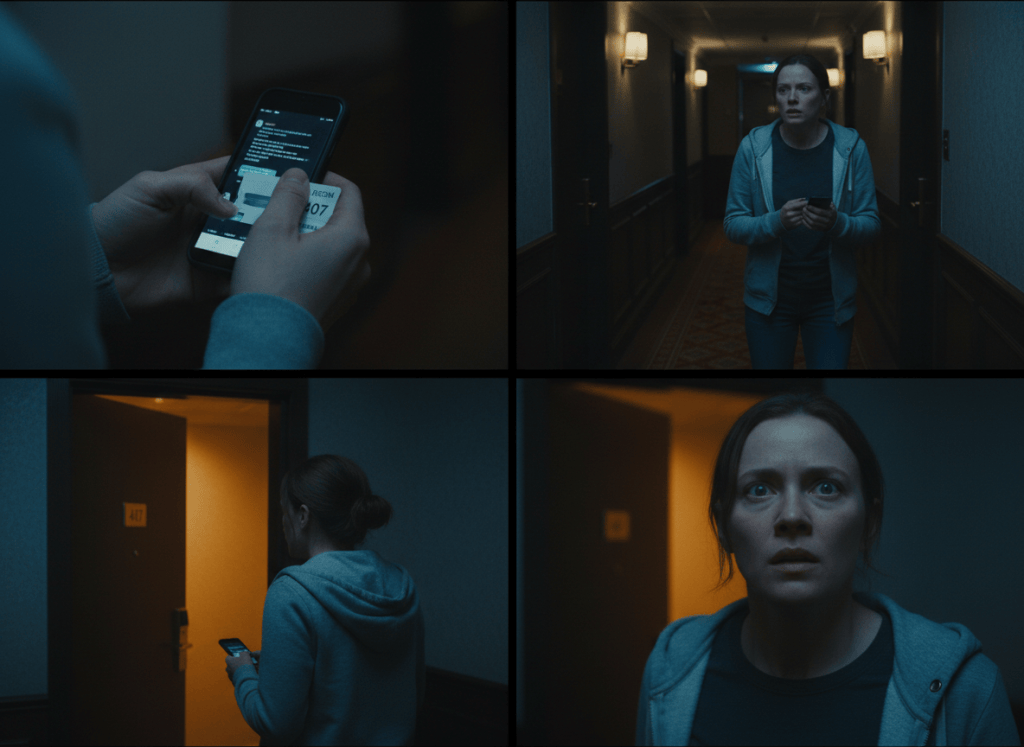
- Door lock: Room 407 should remain in the same corridor position with the same door style and light spilling from inside.
- Prop lock: keep Claire’s phone and keycard consistent, including which hand holds each item.
- Lighting lock: preserve cool hallway shadows and warm room light so the location reads as continuous.
- Watcher lock: if a distant figure appears, keep wardrobe and silhouette recognizable rather than changing the person each shot.
- Fear progression: Claire can become more alert and tense, but do not reset her emotional state after each cut.
Build the Next Scene from an Unanswered Question
- End Scene 1 on the room number or sender ambiguity.
- Scene 2 explores that question but creates a new one: is she being watched?
- Scene 3 answers part of the geography question by reaching the door, then creates a stronger question by finding it open.
- Scene 4 gives evidence, not a full explanation.
- Scene 5 pays off the strongest thread while intentionally leaving one larger question for the audience.
Sound Can Carry Continuity Between Cuts
- Establish a quiet hotel room tone early.
- Repeat distant elevator chimes, ventilation hum or footsteps as recognizable environmental sound.
- Let a sound begin before the cut into the next shot to create a smoother scene handoff.
- Reduce music before an important discovery so small sounds feel larger.
- Avoid constant loud suspense music; contrast creates more tension.
Common Thriller Mistakes
- Showing the watcher too clearly before mystery has time to build.
- Changing the hotel hallway layout from shot to shot.
- Introducing unrelated scary objects instead of developing the message, door and personal clue.
- Making Claire act fearless immediately after a frightening discovery.
- Explaining the entire mystery in one speech instead of paying off clues visually.
Expand Room 407 without Losing Tension
Add scenes by deepening the same chain of evidence: message metadata → hallway camera → open room → personal object → hotel record → connection to Claire’s past. Each discovery should answer part of the previous question and create the next one. That lets the thriller become longer without becoming random.
FILM STUDIO STRATEGY
Control What the Audience Knows
Suspense comes from timing. Tell Film Studio when to reveal information and when to stay on the character’s face so the audience experiences the uncertainty with her.
Copy This Film Studio Prompt
Create a 55–60 second Film cinematic horizontal 16:9 suspense thriller titled “Room 407.” Use the attached reference board as the authoritative visual continuity reference for Claire’s face, wardrobe, phone, hotel keycard, the exact hallway geometry, Room 407 door, lighting, and any watcher silhouette. Keep the story primarily in one hotel floor so tension deepens instead of jumping between random locations.

Open with an immediate hook: Claire’s phone vibrates in an otherwise silent elevator. Extreme close-up of the message: “ROOM 407. COME ALONE. 11:47 PM.” The elevator doors open. Claire looks up into a long dim corridor. She whispers, “This is a mistake,” but steps out.

Stay in the hallway for the first major dramatic beat. Show Claire physically moving past doors 401, 403, and 405 toward 407 so the geography remains clear. Preserve which hand holds the phone and keycard, her coat, hair, and the cool hallway shadows. She hears footsteps behind her, turns, and sees only a distant figure near the elevator. When she looks again, the figure is gone.

Claire reaches Room 407. The door is already open by several inches and warm light spills into the hallway. Do not teleport her inside. Let her stop, listen, push the door slowly, and react to what she sees. Her phone receives another message: “YOU CAME.” Claire says, “Who is this?” No answer.

Inside the room, keep the investigation connected and restrained. The room looks recently occupied: one warm lamp, a half-filled glass, a chair slightly pulled out, and an old photograph on the table. Claire picks up the photograph and realizes it shows her years earlier beside someone whose face has been scratched away. A hotel phone rings once. She answers. A distorted voice says, “You asked me to make you forget.” Claire freezes.

Let the turning point play through reaction, breathing, and one deeper line rather than adding random horror imagery. Claire says, “Forget what?” The voice answers, “Why you were here.” The line goes dead. She turns toward the closet as a faint sound comes from inside, but do not show graphic violence.

End on a clear episode hook: Claire’s phone lights up with a final message: “407 — DON’T OPEN THE CLOSET.” Hold on her face. The closet handle slowly turns by itself. Cut to black before the door opens.

Use controlled camera movement, long hallway depth, practical warm-vs-cool lighting, close-ups of the phone, keycard, room number and photograph, subtle footsteps, elevator chimes, ventilation hum, sparse low strings, and subtitles for all dialogue. Keep every shot geographically consistent and begin each new shot from the exact physical and emotional state where the prior shot ended.
TRY THIS IN SHIMUV