FILM STUDIO MATURE ROMANCE TUTORIAL
This story works because the secret is not the romance — it tests the romance. Keep the focus on two older people forming a sincere connection before money complicates what they believe about each other.

Story Concept
Arthur is a quiet billionaire in his 60s who intentionally lives simply outside his business world. He meets Evelyn, an independent older woman who appreciates his kindness and humor without knowing his wealth. Their relationship deepens until the truth threatens the trust they built.
Build Your Characters
- Arthur — kind, understated, quietly wealthy and emotionally sincere.
- Evelyn — graceful, independent and unimpressed by status.
- Optional assistant or family member — creates pressure when Arthur’s identity risks being exposed.
Scene Plan
- Arthur and Evelyn meet naturally over coffee or a small kindness.
- Their friendship grows through ordinary moments.
- A subtle detail threatens to reveal Arthur’s hidden life.
- Evelyn learns the truth and questions whether the relationship was real.
- Arthur proves through action that love matters more than status.
Visual & Emotional Direction
- Use golden-hour warmth and close, comfortable framing.
- Keep luxury cues subtle until the reveal.
- Let gentle humor and everyday conversation establish chemistry.
- Show affection through looks, gestures and trust rather than spectacle.
Build the Relationship Before You Build the Reveal
The hidden-billionaire idea works only if the audience first believes Arthur and Evelyn enjoy each other without status. Build several ordinary emotional beats before the reveal. Then the wealth becomes a trust problem, not the reason the romance exists.
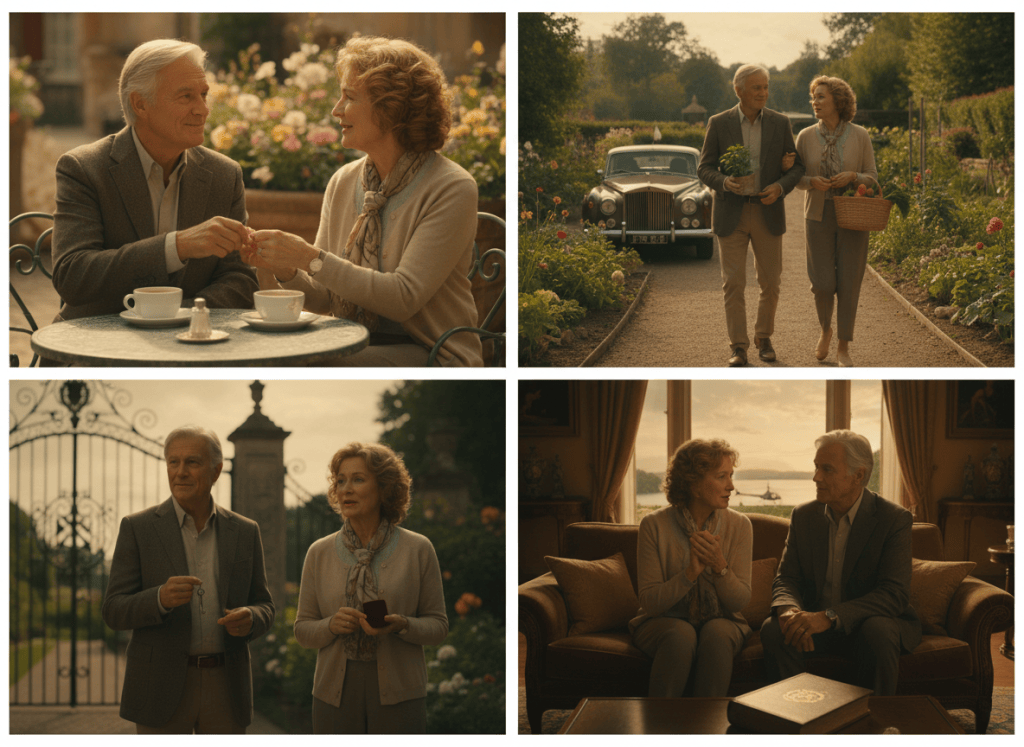
Use a Relationship-First Scene Ladder
| Scene | Carry Forward | What Changes | Why It Matters |
|---|---|---|---|
| 1 · Meeting | Arthur and Evelyn as ordinary people | A small act of kindness creates connection | Establish chemistry without wealth |
| 2 · Familiarity | Warmth from the first encounter | They share time, humor or personal history | Earn trust |
| 3 · Clue | Established affection | A car, assistant, call or location hints at money | Create a question without a full reveal |
| 4 · Truth | Relationship history and trust | Evelyn learns Arthur is a billionaire | Turn the secret into an emotional conflict |
| 5 · Choice | Everything they built before the reveal | Arthur explains his fear; Evelyn decides what matters | Pay off character, not luxury |
Let the World Change without Changing the People

- Arthur lock: preserve his face, salt-and-pepper hair, understated elegance and gentle manner even after his wealth is exposed.
- Evelyn lock: keep her independent personality, wardrobe language and boundaries consistent; do not make her suddenly impressed by wealth.
- Relationship lock: later scenes should reference ordinary moments they shared before the reveal.
- Luxury progression: move from nearly invisible cues to unmistakable evidence rather than opening with mansions and cars.
- Emotional continuity: Evelyn’s hurt should come from secrecy or trust, not from the fact that Arthur has money.
Prompt the Reveal in Stages
- Start with Arthur’s public life and establish what Evelyn reasonably believes about him.
- Add one clue that can be explained away.
- Add a second clue that makes the audience more certain than Evelyn.
- Reveal the truth through a story event—a charity event, business emergency, employee recognition or unavoidable public moment.
- Follow the reveal with a private scene. The emotional aftermath is more important than the glamorous setting.
Camera Choices for Mature Romance
- Use comfortable two-shots to show companionship rather than constant glamour close-ups.
- Use hands, coffee cups, shared walking pace and small gestures to show affection.
- Keep luxury in the background before the reveal so it does not overpower the people.
- During the trust conflict, reduce visual spectacle and stay close to faces and pauses.
- End with an action that restores honesty rather than a display of wealth.
Common Hidden-Wealth Story Mistakes
- Making the billionaire reveal the first interesting thing about Arthur.
- Skipping the ordinary scenes that prove why Evelyn likes him.
- Changing Arthur’s personality once the luxury setting appears.
- Reducing Evelyn to surprise or admiration instead of giving her a real trust decision.
- Resolving hurt with an expensive gift instead of honesty and changed behavior.
Expand This into a Longer Romance
Add length by developing shared ordinary life before shared extraordinary life: recurring cafe visits, meeting friends, helping with a small problem, learning each other’s routines, then increasing pressure from Arthur’s hidden business world. The reveal becomes stronger because the audience has more relationship history to protect.
FILM STUDIO STRATEGY
Make the Reveal Test Trust
The billionaire reveal should change the emotional stakes, not turn the story into a luxury montage. Keep the audience invested in why these two people choose each other.
Copy This Film Studio Prompt
Create a 60-second Film cinematic horizontal 16:9 mature romantic drama titled “Ordinary Coffee.” Use the attached reference board as the authoritative visual continuity reference for Arthur’s and Evelyn’s identities, age, wardrobe language, recurring café/garden settings, and the subtle visual progression from ordinary life into visible wealth. Keep the story to no more than 3 major locations and spend real time building their relationship before the reveal.

Open with a 2–3 second hook in a warm neighborhood café: Evelyn accidentally drops a glove beside Arthur’s table. He picks it up and says, “I think this is yours.” She smiles, notices he has been reading the same book she loves, and says, “That depends. Are you going to make me buy you coffee to get it back?” Begin with gentle humor, not wealth.

Stay in the café for the first major dramatic beat. Let Arthur and Evelyn talk naturally about ordinary things—books, routines, retirement, family, and why each still comes to the same café. Use comfortable two-shots, hands around cups, and pauses. Arthur dresses well but nothing should clearly reveal billionaire status. A subtle clue may appear, such as a discreet call he declines or a driver waiting outside, but Evelyn does not investigate it yet.

Use the second major location, a nearby garden walk or neighborhood terrace, to deepen the connection. Show them physically moving through the environment together rather than cutting between unrelated romantic images. Arthur admits that he spent many years building a life he no longer wants to be defined by. Evelyn says, “Then stop introducing yourself through what you’ve done.” Let that line matter to him.

Introduce the reveal through a story event, not a luxury montage. Arthur invites Evelyn to what she believes is a small charity gathering. At the third location, an elegant event space, employees and guests recognize him as the founder and billionaire benefactor. Evelyn realizes that Arthur deliberately withheld a major part of his life. Preserve Arthur’s gentle manner and Evelyn’s independent personality; do not suddenly make either character glamorous caricatures.

Give the emotional conflict time. Evelyn asks privately, “Was any of it real?” Arthur answers, “The coffee was. The walks were. Me asking if I could see you again—that was the most honest thing I’ve done in years.” Evelyn explains that the money is not what hurt; the secrecy made her wonder whether he trusted her.

End on a hopeful but earned resolution at a quiet terrace outside the event. Arthur does not offer an expensive gift. He asks, “Coffee tomorrow?” Evelyn replies, “Coffee tomorrow. No secrets.” They share a small smile. As they turn to leave, Arthur’s assistant approaches with a major business crisis. Arthur looks at Evelyn before answering, signaling that his two worlds are about to collide. Cut to black.

Use warm golden-hour tones, natural mature performances, subtle humor, intimate close-ups, comfortable two-shots, understated luxury cues before the reveal, restrained score, café ambience, city sounds, soft strings, and subtitles for all dialogue. Each connected shot must preserve identity, wardrobe, relationship history, and emotional state; the reveal should test trust, not replace the romance.
TRY THIS IN SHIMUV