FILM STUDIO ACTION TUTORIAL
Action gets stronger when every movement has a reason. Define who is chasing whom, what the protagonist must protect, where the escape route is, and exactly what success looks like before Film Studio begins.
Story Concept
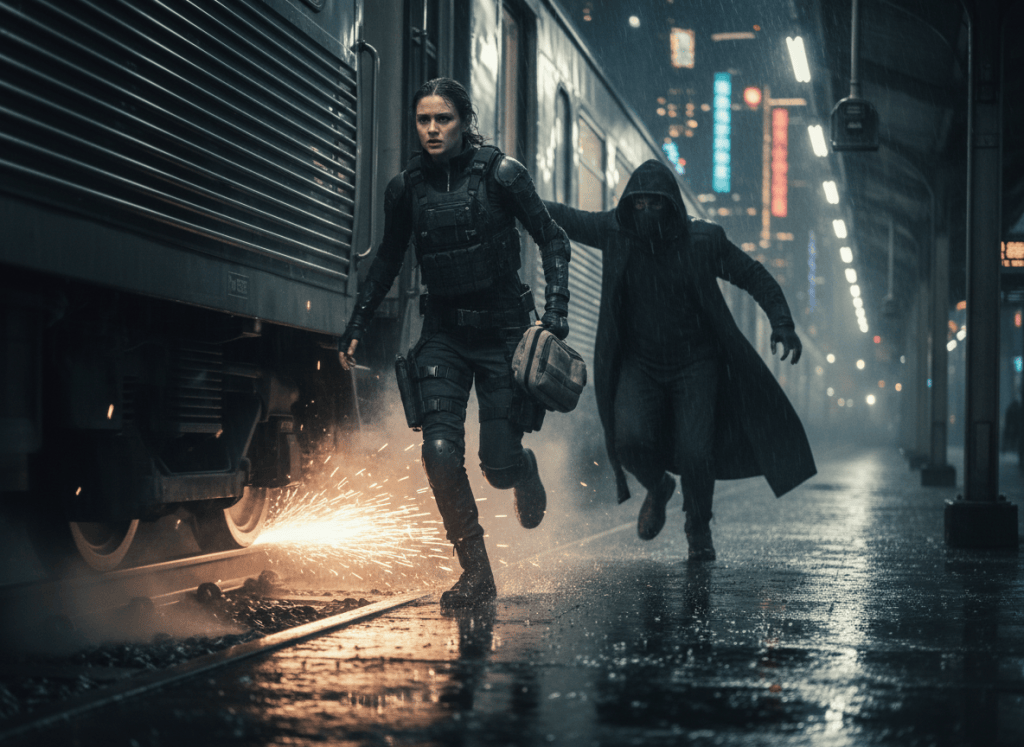
Zara must cross a night train platform with critical evidence before the last train leaves. A hooded pursuer is closing in, and every second forces her to choose between speed and protecting the evidence.
Build Your Characters
- Zara: athletic, determined, slightly injured, focused on the mission.
- Pursuer: hooded, physically imposing and mysterious.
- Optional ally: conductor, officer or friend waiting near the train.
5-Scene Plan
- Zara enters the platform already running.
- The pursuer closes the distance through trains, steam and obstacles.
- Zara is briefly trapped or drops the evidence.
- She recovers and outmaneuvers the pursuer.
- She boards the last train or transmits the evidence seconds before capture.
Example Dialogue
Zara: “If I stop running, everyone loses.”
Pursuer: “You were never supposed to make it this far.”
Ally: “Get on the train. I’ll hold the door.”
Visual & Camera Direction
- Start with a wide establishing shot so the audience understands the platform.
- Track alongside Zara during the chase.
- Cut to hands, feet and the evidence for urgency.
- Preserve injuries, clothing and the evidence object across scenes.
Copy This Film Studio Prompt
Create a cinematic action short film in ShiMuv Film Studio called “The Last Train.” Main character: Zara, a determined young woman in dark tactical clothing with a small facial injury, carrying critical evidence. Antagonist: a hooded pursuer dressed in black. Setting: a wet train platform at night with city lights, sparks, steam and moving trains. Create 5 connected scenes: Zara runs toward the last train; the pursuer chases her through the platform; she is briefly trapped or loses the evidence; she recovers and outmaneuvers him; she escapes or delivers the evidence just in time. Include realistic movement, coherent action geography, dynamic camera angles, close-ups of the evidence, consistent costume and injuries, and subtitle-ready dialogue.Build the Action Sequence on Top of the Previous Scene
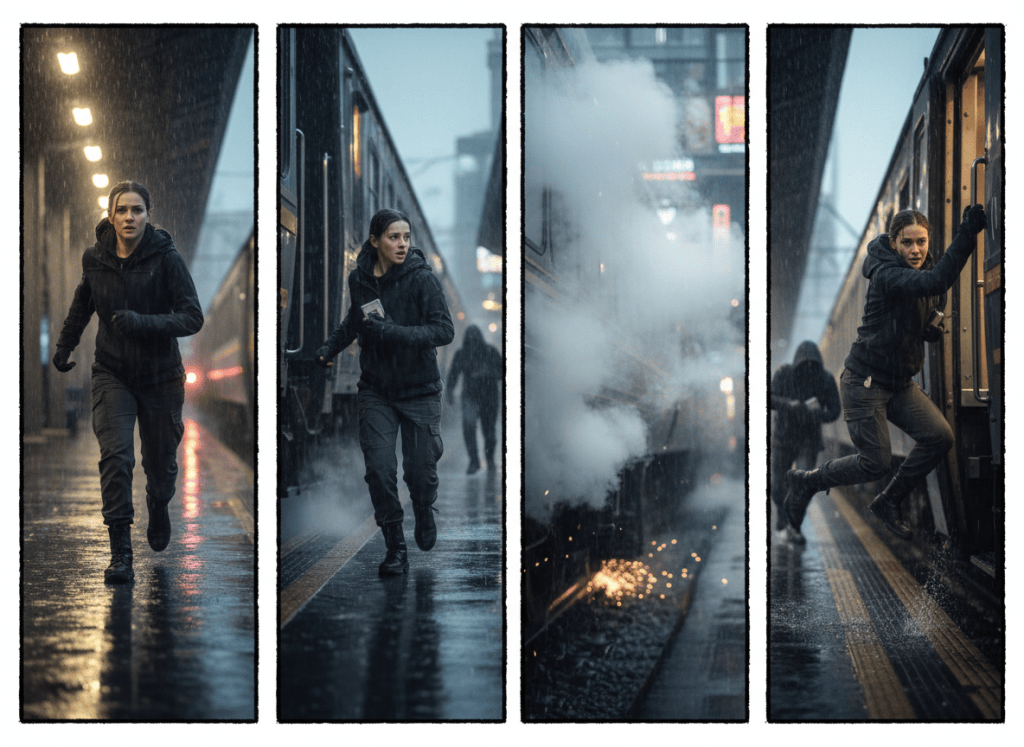
Action becomes easier to follow when every scene preserves a clear goal, geography and prop state. Zara is not simply “running” in every clip. She is trying to reach the last train while protecting evidence, and each scene should make that same objective harder.
Track Goal, Geography and Pressure
| Scene | Carry Forward | Escalate | Exit Beat |
|---|---|---|---|
| 1 · Objective | Zara, evidence, wet platform, last train | Train departure is imminent | She spots the pursuer |
| 2 · Pursuit | Same evidence and direction of travel | Pursuer closes distance | Zara changes route |
| 3 · Obstacle | Same platform geography | Blocked passage, crowd or closing gate | She finds a new path |
| 4 · Final Run | Evidence still in her possession | Train begins to leave | She reaches the door |
| 5 · Payoff | All prior physical and emotional strain | Choice: board, hand off evidence or protect someone | Resolve the immediate objective |
Continuity Is What Makes Fast Action Read Clearly
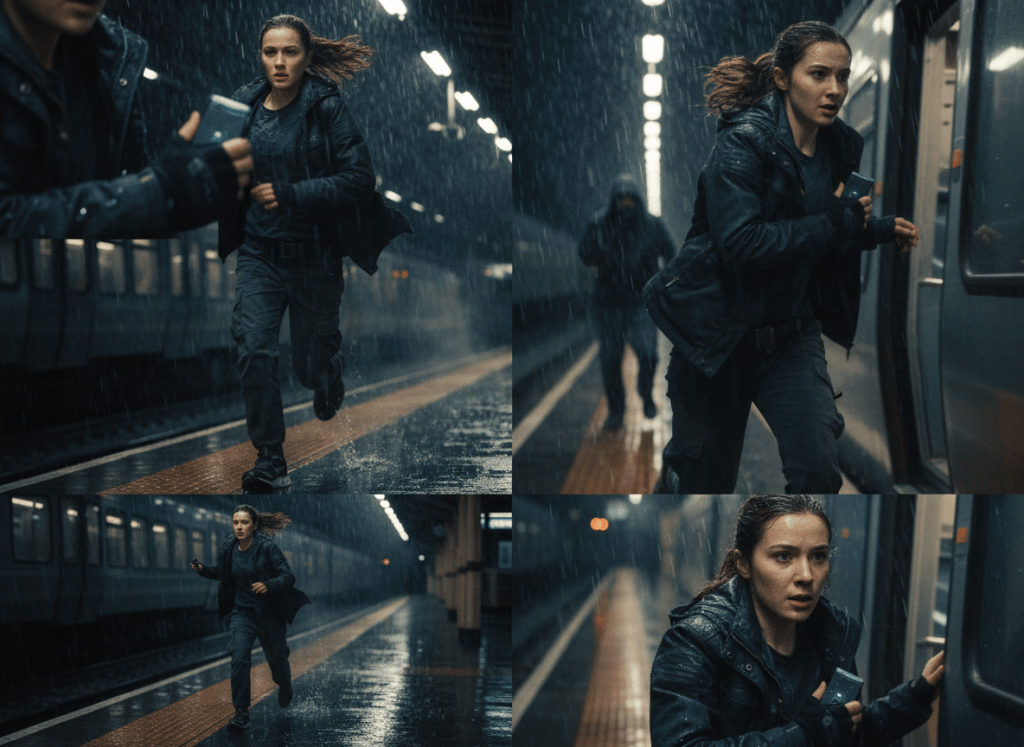
- Direction lock: if Zara is running toward the train from left to right, avoid reversing direction without an establishing shot.
- Prop lock: specify where the evidence is—right hand, jacket pocket or bag—and update that state only when the story shows the change.
- Wardrobe lock: keep the same jacket, hair and wet-weather condition across scenes that occur continuously.
- Damage/fatigue lock: if she becomes soaked, dirty or exhausted, later scenes should retain that history.
- Location lock: reuse recognizable station elements so the audience understands where she is moving.
Prompt the Next Scene from the Last Frame
- End Scene 1 with Zara looking toward the approaching train or noticing the pursuer.
- Begin Scene 2 by explicitly continuing from that look and preserving her position, clothing, evidence and weather.
- End Scene 2 with a physical decision—turn down stairs, jump a barrier, enter a carriage corridor.
- Begin Scene 3 at that exact decision point instead of resetting her somewhere unrelated.
- Reserve the biggest movement or visual event for the payoff scene so escalation has shape.
Build Shot Size with the Intensity
- Wide shots establish platform geography and train position.
- Medium tracking shots show Zara’s movement and obstacles.
- Insert close-ups show evidence, phone, train doors or the departure clock.
- Tight reaction shots communicate fear or resolve at decision points.
- Return to a wide payoff shot when she finally reaches or misses the objective.
Common Action-Scene Mistakes
- Generating exciting shots without making it clear where Zara is going.
- Letting the evidence disappear between scenes.
- Changing rain, time of night or train design in a continuous sequence.
- Making every scene equally intense instead of building pressure.
- Adding a new pursuer or obstacle without first paying off the previous one.
Expand the Sequence without Repeating the Chase
To make the film longer, add different kinds of obstacles, not more running: an information problem, a route problem, a trust problem and finally a time problem. That lets an action sequence grow while Zara’s objective remains easy to understand.
TRY THIS IN SHIMUV