FILM STUDIO BIBLICAL STORY TUTORIAL
Biblical storytelling benefits from restraint, continuity and respect for the source. For Ruth and Naomi, the emotional center is loyalty through loss, faithful provision, and the gradual movement from grief toward restoration.
Story Focus
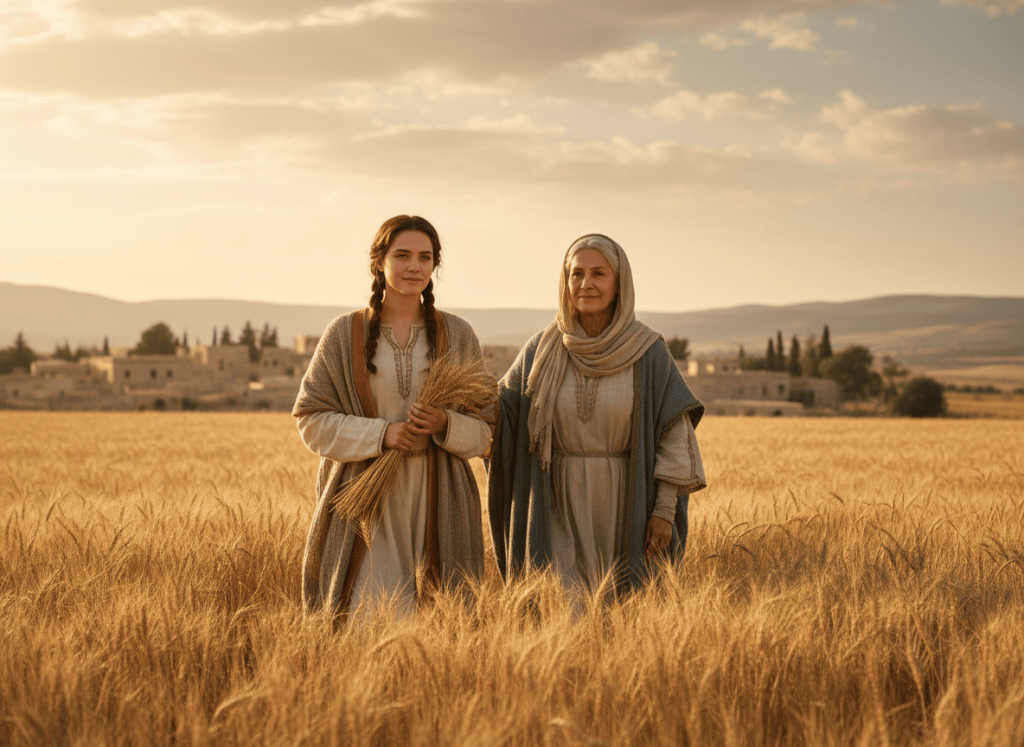
The Book of Ruth moves through loss, commitment, work, kindness and restoration. A short-film adaptation cannot include every detail, so choose moments that preserve the story’s core movement: Naomi’s return, Ruth’s decision to stay with her, Ruth gleaning in the fields, Boaz recognizing her faithfulness, and the hope that follows.
Character Continuity
- Ruth — younger woman, steadfast, humble and courageous.
- Naomi — older woman carrying grief, wisdom and deep history.
- Boaz — honorable, observant and generous without overshadowing Ruth and Naomi’s bond.
Scene Plan
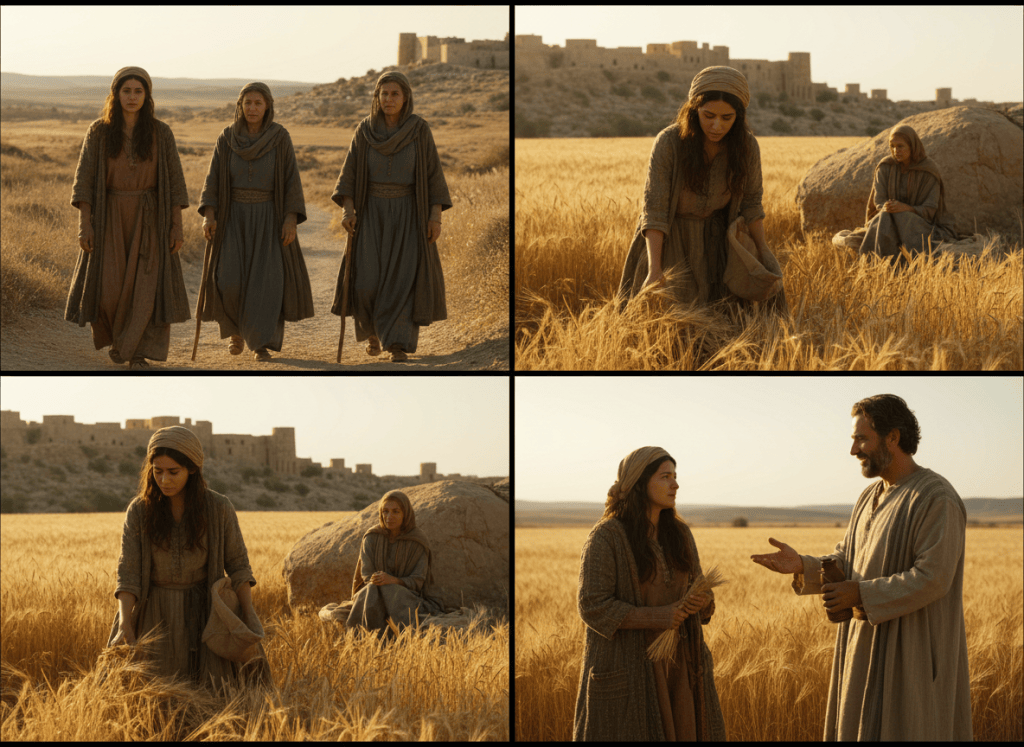
- Naomi prepares to return to Bethlehem after loss.
- Ruth chooses to remain with Naomi and journey with her.
- Ruth gleans in the fields to provide for them.
- Boaz notices Ruth’s faithfulness and treats her with kindness.
- End with a sense of provision, restoration and a future being opened.
Historical & Visual Direction
- Use historically inspired ancient Near Eastern clothing, architecture and agricultural settings rather than modernized fantasy styling.
- Keep Ruth and Naomi visually consistent across travel, field and home scenes.
- Use warm natural light, wheat fields and stone village environments to support the story’s grounded tone.
- When using direct Scripture, preserve the wording accurately; otherwise label connective dialogue as paraphrase or dramatization.
Build the Biblical Film from the Source, Not Around It
For a biblical adaptation, scene building begins with a source map. Before adding cinematic detail, separate what the biblical text actually establishes from historically inspired visual reconstruction and from connective dramatization. That keeps added scenes useful without allowing invented material to replace the account you are adapting.
Use Three Labels in Your Production Notes
- Biblical event: something the Book of Ruth explicitly establishes and that should remain unchanged.
- Historical reconstruction: setting, clothing, tools, agriculture or daily-life detail used to make the world visible. When uncertain, describe it as historically inspired rather than as a biblical fact.
- Dramatic bridge: a small action, transition or paraphrased line that helps connect two established events without changing their meaning.
Let Each Scene Inherit the Biblical and Emotional Context
| Scene | Source Anchor | Cinematic Layer | Handoff |
|---|---|---|---|
| 1 · Return | Naomi is returning toward Bethlehem after profound family loss | Journey preparation, landscape and grief carried in behavior | Ruth must decide whether to remain with her |
| 2 · Loyalty | Ruth chooses to stay with Naomi | Travel, quiet companionship and the cost of leaving what is familiar | They arrive needing provision |
| 3 · Gleaning | Ruth gleans to provide | Field labor, repeated physical detail and visible persistence | Her faithfulness becomes known in Boaz’s field |
| 4 · Kindness | Boaz responds to Ruth with kindness and provision | Respectful field interaction and reaction shots | Ruth carries the evidence of provision back to Naomi |
| 5 · Hope | The account moves toward restoration and a new future | End the short at a truthful point of hope rather than inventing a new climax | For a longer film, continue from the biblical account |
Lock Character, Period and Source Continuity
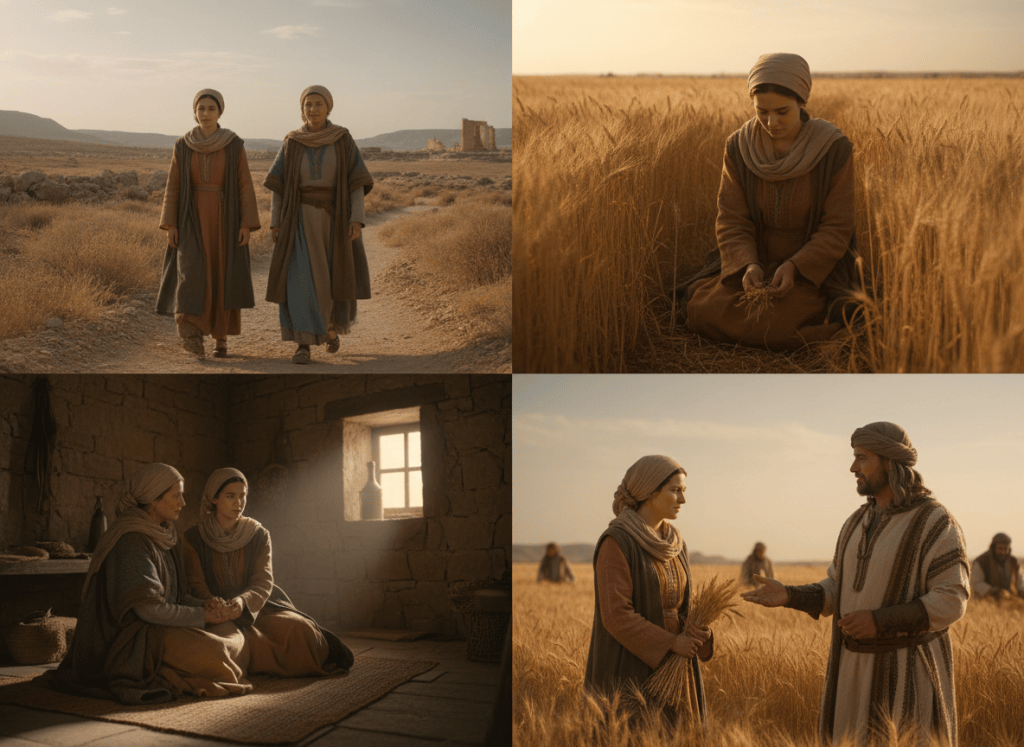
- Character lock: keep Ruth, Naomi and Boaz recognizable by face, age range, robe palette, head coverings and manner throughout the film.
- Period lock: keep architecture, containers, farming tools and clothing within one historically inspired ancient Near Eastern visual world; avoid accidental modern objects.
- Source lock: once you establish the event being adapted, later prompts must not contradict or replace it with a more sensational invented event.
- Dialogue lock: if you use direct biblical wording, verify it against the translation you chose. Otherwise use careful paraphrase or clearly connective dramatization.
- Relationship lock: the Ruth–Naomi bond remains the emotional foundation even when Boaz becomes important to the story.
Build the Next Prompt with a Source Anchor
A useful scene prompt can follow this order: Source anchor → inherited continuity → new action → historical visual context → emotional objective → camera plan → handoff beat. For example, do not prompt a fresh “beautiful wheat-field scene.” Tell Film Studio that this scene continues after Ruth and Naomi’s arrival, preserves Ruth’s established face and clothing, shows Ruth gleaning because they need provision, and ends on the first credible indication that someone in the field has noticed her faithfulness.
- Write the biblical event or passage reference in your private production notes before generating.
- Copy forward every character and period detail that should remain stable.
- Add only the new action needed for this point in the account.
- Add environment and camera details that illuminate the event without changing it.
- End on a visual or emotional beat that leads naturally into the next source-grounded scene.
Use Camera Choices to Support the Meaning
- Journey scenes: wider compositions emphasize distance, uncertainty and companionship.
- Loyalty scenes: closer two-shots keep Ruth and Naomi’s relationship central.
- Gleaning scenes: hands, grain and repeated work make provision tangible instead of merely narrated.
- Boaz scenes: medium respectful framing can show his response without making him dominate the story too early.
- Return-to-Naomi scenes: reaction and shared-space shots reconnect the field events to the relationship at home.
Common Biblical-Adaptation Mistakes
- Inventing a dramatic miracle, confrontation or villain simply because it looks cinematic.
- Presenting uncertain costume or cultural details as though Scripture explicitly describes them.
- Making Boaz the center before the Ruth-and-Naomi relationship has been established.
- Using direct-sounding dialogue without checking whether it is Scripture, paraphrase or invention.
- Jumping between visual eras or unrelated architectural styles.
- Compressing so aggressively that the reason for Ruth’s work and loyalty becomes unclear.
Expand Ruth & Naomi into a Longer Film
For a longer adaptation, build a scene map from the biblical sequence before generating. A useful structure is: loss and return → Ruth’s commitment → arrival in Bethlehem → gleaning → Boaz’s kindness → Ruth reporting back to Naomi → Naomi’s counsel → the later redemption events → marriage and the account’s closing perspective. For every added scene, keep a simple three-column note: what the text establishes, what continuity must carry forward, and what visual or connective dramatization you are adding. That lets the film grow in depth without quietly turning into a different story.
BIBLICAL STORY STRATEGY
Let the Source Lead the Drama
Do not manufacture a different plot simply to make the film more dramatic. Let the human emotion already present in the biblical account carry the film: grief, loyalty, labor, kindness, trust and restoration.
Copy This Film Studio Prompt
Create a reverent biblical story short film in ShiMuv Film Studio inspired by the Book of Ruth, centered on Ruth and Naomi. Keep the storytelling respectful to the biblical account and avoid sensationalizing or rewriting the core events. Visual style: historically inspired ancient Near Eastern settings, modest period clothing, wheat fields, stone villages and warm natural light. Create 5 connected scenes: after loss and hardship, Naomi prepares to return to Bethlehem; Ruth chooses to remain with Naomi and journey with her; Ruth gleans in the fields to provide for them; Boaz notices Ruth’s faithfulness and treats her with kindness and protection; end with a hopeful sense of provision, restoration and a new future. Use dialogue that is either directly grounded in Scripture or careful paraphrase, clearly separating biblical text from connective dramatic dialogue. Preserve Ruth, Naomi and Boaz consistently across scenes. Emphasize loyalty, faith, provision and restoration, with cinematic but reverent pacing and subtitle-ready dialogue.
TRY THIS IN SHIMUV