FILM STUDIO FANTASY TUTORIAL
Fantasy films feel coherent when the hero, the magical rule, the destination and the emotional purpose are all defined. Build the world around a clear journey instead of disconnected spectacular images.

Story Concept
Lyra has always felt connected to the stars. When an impossible celestial sign appears, it points toward a hidden kingdom and begins a journey that tests whether she is willing to follow the calling she has sensed all her life.
Build Your Characters
- Lyra — brave, curious and spiritually attuned to the stars.
- A loyal animal companion — visual continuity and emotional support.
- An optional guide or elder — gives context without taking over the journey.
Scene Plan
- The celestial sign appears.
- Lyra understands it is calling her somewhere.
- She crosses magical landscapes.
- She faces one meaningful non-graphic test.
- She reaches the destination and sees her purpose differently.
Visual & Camera Direction
- Use sweeping establishing shots for scale.
- Frame Lyra against celestial light to show wonder and destiny.
- Repeat visual motifs from the stars throughout the journey.
- Keep costume, companion and physical features consistent scene to scene.
Build the Fantasy World Around the Quest
A fantasy film can become a collection of beautiful locations unless every place changes the hero. Let the celestial sign, Lyra’s purpose and her companion form the spine. Each new setting should answer a question, test a belief or reveal the next part of the route.
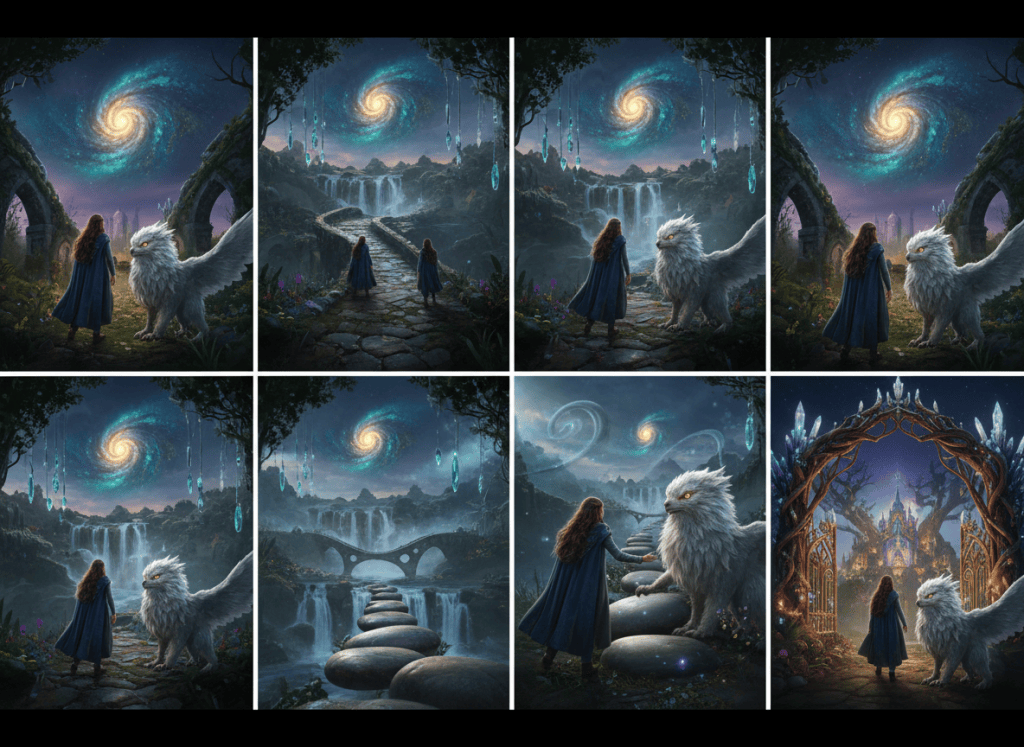
Make Every Location Advance the Same Quest
| Scene | Carry Forward | World Addition | Story Purpose |
|---|---|---|---|
| 1 · Calling | Lyra, blue cloak, companion | Celestial sign above ruins | Give the journey a direction |
| 2 · Route | Sign motif and established character design | Bridge, waterfall or ancient path | Show progress toward the destination |
| 3 · Test | Same route history and companion | Nonviolent magical obstacle | Reveal Lyra’s character |
| 4 · Threshold | What she learned during the test | First view of hidden kingdom | Turn wonder into a decision |
| 5 · Arrival | All visual motifs and emotional growth | Destination or sacred place | Reveal what the journey means |
Use a Visual Bible for the Hero, Companion and Magic
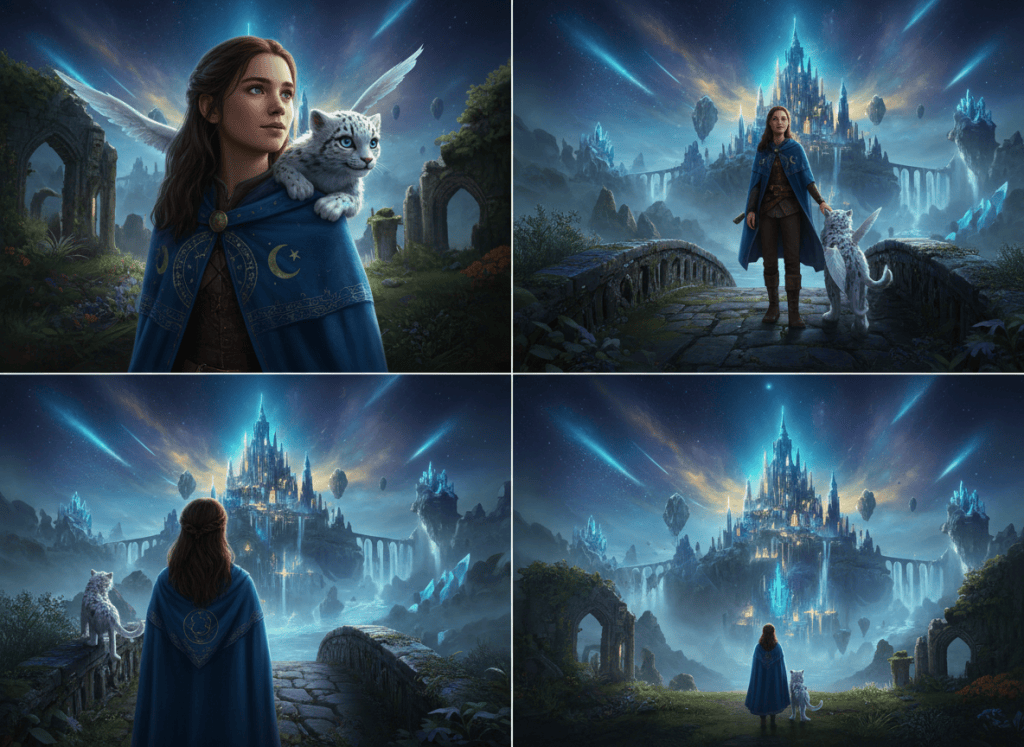
- Hero lock: repeat Lyra’s face, hair, blue cloak, boots and key accessories.
- Companion lock: define species, size, markings and behavior so the animal does not transform between scenes.
- Magic lock: give the celestial sign a consistent color, shape and visual behavior.
- World rule: decide what kind of architecture, vegetation, skies and materials belong to this kingdom.
- Journey state: clothing may become dusty or wet as Lyra travels; preserve those changes rather than resetting her appearance.
Prompt from the Route, Not from a New Image Idea
- Define the starting location and destination relationship in Scene 1.
- Scene 2 should clearly move Lyra closer, farther or deeper—not just place her somewhere pretty.
- Scene 3 uses an obstacle that relates to the world’s rules or Lyra’s weakness.
- Scene 4 visually repeats the celestial motif so the audience recognizes the threshold.
- Scene 5 pays off both the external destination and Lyra’s internal change.
Design Camera Scale around Wonder
- Use wide frames when the world should feel larger than Lyra.
- Use medium frames during decisions and companion interactions.
- Use close-ups when the celestial sign changes meaning emotionally.
- Repeat a similar composition at the beginning and end to show how Lyra has changed even if the visual motif remains.
Common Fantasy Mistakes
- Changing the rules of magic whenever a scene needs an easy solution.
- Adding a new creature or kingdom in every shot without narrative purpose.
- Letting Lyra’s cloak, companion or celestial symbol change design.
- Using spectacle without showing how the journey affects the character.
- Reaching the destination without paying off clues established earlier.
Expand the Quest into a Longer Film
Build a longer adventure by turning the route into meaningful stages: calling → preparation → departure → first guide → first test → setback → deeper revelation → threshold → arrival. Each stage can contain multiple scenes, while the same celestial sign and destination keep the story unified.
FILM STUDIO STRATEGY
Make the World Serve the Quest
Describe the magical world in relation to what Lyra must learn. The strongest fantasy scenes are not only beautiful — each location moves the story forward.
Copy This Film Studio Prompt
Create a 60-second Film cinematic horizontal 16:9 fantasy adventure titled “The Star Road.” Use the attached reference board as the authoritative visual continuity reference for Lyra’s identity, long dark hair, blue cloak, boots, companion, celestial seven-star symbol, and the fantasy world’s architecture and color language. Keep the story to no more than 3 major locations and let each place develop through several connected shots before moving on.

Open with a 2–3 second hook at Moonwatch Ruins at night: extreme close-up of Lyra’s eye reflecting seven stars that suddenly arrange themselves into a perfect crown-shaped constellation above the broken observatory. Her animal companion looks up and growls softly. Lyra whispers, “That wasn’t there before.”

Stay at Moonwatch Ruins long enough to establish the calling. Lyra moves beneath the eastern arch, physically passing cracked columns and a waterfall gorge. The seven-star symbol appears again in a moss-covered celestial mosaic at the base of the arch. She clears the moss with her hand and reveals a map pointing toward a distant crowned city. Preserve her blue cloak, damp hem, companion markings, night lighting, and the exact star symbol. Lyra says, “It’s a road.”

Move into the second major location, the Ascending Vale, only after she chooses to follow the map. Show real travel through connected space: Lyra and her companion climb a mountain path, pass three recognizable standing stones, cross beside levitating cascades, and gain visible elevation. Do not show walking or running in place. Each shot should end farther along the same route. As dawn begins, the standing stones ignite one by one with the same seven-star motif.

Use the vale for the story’s meaningful test. Lyra reaches the Starless Span, a broken bridge over luminous cloud. A narrow sequence of ancient stepping stones appears only when she moves forward without turning back. Her companion refuses the first step. Lyra kneels, touches its head, and says, “We go together.” Let the courage beat and their reactions develop before the crossing. Preserve damp clothing, map state, direction of travel, and emotional continuity.

Move into the third and final location only after the bridge is crossed: the Gate of Asterra overlook at sunrise. Begin on Lyra’s reaction before showing the destination. Then widen to reveal a celestial city beyond the mountains, with waterfalls, towers, and the crown constellation glowing faintly above it. Lyra realizes the sign was not simply guiding her to a kingdom—it was calling her home.

End on an episode hook: the mosaic map in Lyra’s hand changes. A second unfamiliar symbol appears beyond Asterra. Her companion looks toward it. Lyra smiles slightly and says, “So this is the beginning.” Cut to black.

Use sweeping establishing shots for scale, intimate reaction shots for emotional beats, consistent magical rules, realistic travel progression, celestial ambience, wind, waterfalls, low orchestral strings, choir textures used sparingly, and subtitles for all dialogue. Every shot must begin from the exact physical, prop, wardrobe, location, and emotional state where the previous shot ended.
TRY THIS IN SHIMUV